Underfloor Heating For Cold Tiled Floors
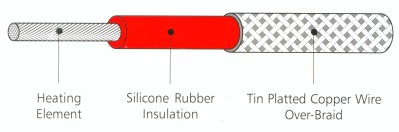
Tile and stone floors in bathrooms, hallways and kitchens don't have to be cold to the touch any more. New technology has made it possible to develop a heating cable which is fairly small in diameter. Together with the grout, this raises the thickness of the floor by about 10mm. Heating cable diameter is approximately 6mm and is over-braided with tin platted copper to reduce EMF to negligible levels. This heating cable provides even heat distribution and installation is very simple.
Heating cable is insulated with high quality silicone rubber (suitable for applications between -60 deg. C and +250 deg.C). All heating cable units are fully factory terminated with 3 metre cold leads. All the installer needs to do is lay the cable onto the floor in loops by spacing evenly and then connect to the temperature controller.
We shall recommend a heating cable unit to match the square metres of floor area you need to heat. Usually 60 watts per square metre is required in houses which are newly built or have supplementary insulation, 80 watts per square metre in houses which are older. Power supply should be 230V ac. Heating cable output is 10 watts / metre.
Underfloor Heating Systems Installation Testing
Heating cable should be tested with a 500V DC insulation tester, for insulation and continuity, prior to cable laying. The insulation resistance should not be less than 100 mega ohms. This test should be repeated again after laying the cable.
Installation
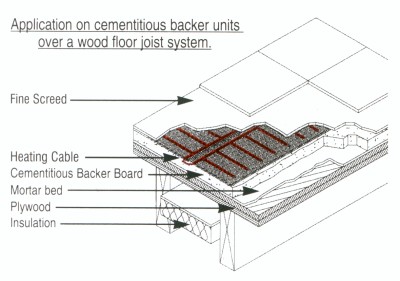
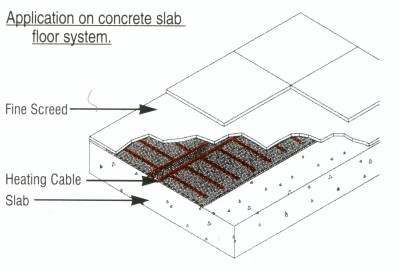
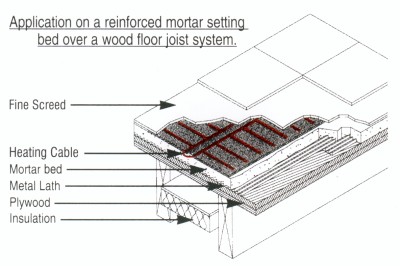
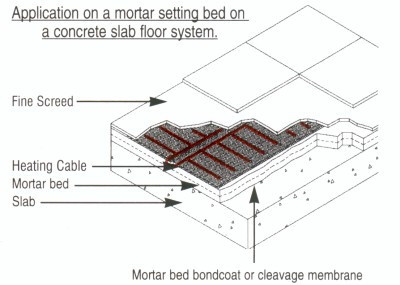
Clear surface free from debris. It is essential to sweep the floor before laying commences to remove any sharp objects which might damage the cable. Fix welded wire mesh (usually 1mm sq. O.D. wire welded into 15mm squares) to the concrete base by using hardened nails, where waterproof membrane is used dabs of hot bitumen can be applied. Now determine the starting point on the plan ensuring both cold tails return to this point, allowing for the cold tail connections. Lay the cable in accordance with the recommended pitch to achieve the watts/metre square required for a particular application. Heating cable should not touch or cross, or be in direct contact with any insulation material. Cold tail/heating joints should be spaced at least 50mm apart and buried in the concrete floor. Tie the cable to the wire mesh at every 20cm using cable ties. Cable runs may be transverse or longitudinal onto a flat surface, but when steps are involved, transverse runs should be used with the cable dropping down the riser to each lower step. A fine concrete screed should be used for surfacing and may be finished with a continuous layer of asphalt to provide a smooth surface.
Control
For small installations an air sensing or surface sensing stat is sufficient to energise the system when the temperature drops below a set point. For larger installations a more advanced control system may be desirable. So that a low surface temperature does not call for underfloor heating until moisture is deposited upon the surface which would result in freezing. For economy in operation, therefore, providing the surface remains dry, heat is withheld until the surface arrives at, or even falls slightly below, freezing point. Consequently, temperature control is linked with detectors which detect the presence of moisture and of snow. A moisture detector consists of a pair of electrodes placed at surface level, a signal being initiated by the fall of resistance between them which occurs when moisture is present. The detector for snow contains a heater which melts the snow in order to gain the same effect.
